
Growing Your Own Fruit
 Spring is as important time for setting out new fruit trees. Early
spring planting gives young new fruit trees time to get a head start in
their new home before hot summer weather shows up. That increases your
new tree’s chances for success.
Spring is as important time for setting out new fruit trees. Early
spring planting gives young new fruit trees time to get a head start in
their new home before hot summer weather shows up. That increases your
new tree’s chances for success.
Variety
selection is generally at its best, including options with both
container grown trees and something known as bare root trees. Most
people are probably familiar with container grown trees. Simply put,
they are trees growing in a pot. Given proper care, we can have
container grown fruit trees available 365 days a year...and generally we
do. Bare root fruit trees are a little different.
That
term, “bare root”, actually does a pretty good job of describing what
we are talking about. These trees have been dug out of the ground during
the winter and all excess soil is removed from their roots. They
actually now have bare roots. They are kept dormant by then placing them
in them in large coolers that keep the temperatures just above
freezing, mimicking winter-like conditions. Throughout their storage
time, conditions are carefully monitored and the exposed roots are water
on a regular basis to keep them from drying out.
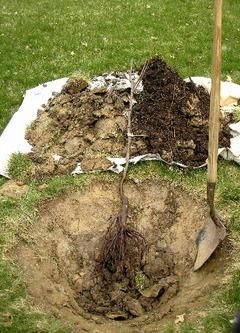 We do both at Skinner’s.
We
have container grown fruit trees in stock, off and on during most of
the year. Bare root fruit trees however, are a spring only item.
Eventually, even trees in a cooler begin to sense spring and need to be
planted out.
Both
types make for good trees to plant out. Our bare root trees are
usually only about one year younger than their potted counterpart. They
are generally considerably cheaper than the potted version, and because
there is no pot full of soil, they are also easier to haul home.
Planting and post-planting care is essentially the same for both as is
overall transplant success.
More
important that which type you are going to plant, is what varieties you
are going to choose ton include in your home orchard? There many
different types of fruit trees we can grow here, including apples,
peaches, pears, cherries, nectarines, apricots and plums as well as
other lesser known fruit trees and even nut trees. All have pros and
cons that should be considered as well as cultural information that is
important for success. We can help you work out that information. There
are a couple of good links below that may help as well. One is to a
K-State Extension publication that goes through some of the basics of
fruit gardening. The other is a link to the “Edible” section of our
catalog. It lists and describes a long list of tasty fruit tree choices.
Now, all you need to do is decide what kind of fruit you want to enjoy. Have fun!


 Maple and Freeman Hybrids (like Autumn Blaze) are some of the most
popular, but don't forget about some other amazing trees you can plant.
Black Gum has stunning red fall color and there are quite a few oaks
that produce great red to red-wine fall color. Think about Shumard Oak,
Scarlet Oak, White Oak and Shingle Oak. If you're in the market for
something smaller then consider Tartarian or Paperbark Maple.
Maple and Freeman Hybrids (like Autumn Blaze) are some of the most
popular, but don't forget about some other amazing trees you can plant.
Black Gum has stunning red fall color and there are quite a few oaks
that produce great red to red-wine fall color. Think about Shumard Oak,
Scarlet Oak, White Oak and Shingle Oak. If you're in the market for
something smaller then consider Tartarian or Paperbark Maple.