Sunday, March 20, 2016

Growing Your Own Fruit 
Spring is as important time for setting out new fruit trees. Early spring planting gives young new fruit trees time to get a head start in their new home before hot summer weather shows up. That increases your new tree’s chances for success.
Variety selection is generally at its best, including options with both container grown trees and something known as bare root trees. Most people are probably familiar with container grown trees. Simply put, they are trees growing in a pot. Given proper care, we can have container grown fruit trees available 365 days a year...and generally we do. Bare root fruit trees are a little different.
That term, “bare root”, actually does a pretty good job of describing what we are talking about. These trees have been dug out of the ground during the winter and all excess soil is removed from their roots. They actually now have bare roots. They are kept dormant by then placing them in them in large coolers that keep the temperatures just above freezing, mimicking winter-like conditions. Throughout their storage time, conditions are carefully monitored and the exposed roots are water on a regular basis to keep them from drying out.
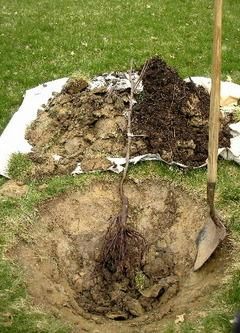
We do both at Skinner’s.
We have container grown fruit trees in stock, off and on during most of the year. Bare root fruit trees however, are a spring only item. Eventually, even trees in a cooler begin to sense spring and need to be planted out.
Both types make for good trees to plant out.  Our bare root trees are usually only about one year younger than their potted counterpart. They are generally considerably cheaper than the potted version, and because there is no pot full of soil, they are also easier to haul home. Planting and post-planting care is essentially the same for both as is overall transplant success.
More important that which type you are going to plant, is what varieties you are going to choose ton include in your home orchard? There many different types of fruit trees we can grow here, including apples, peaches, pears, cherries, nectarines, apricots and plums as well as other lesser known fruit trees and even nut trees. All have pros and cons that should be considered as well as cultural information that is important for success. We can help you work out that information. There are a couple of good links below that may help as well. One is to a K-State Extension publication that goes through some of the basics of fruit gardening. The other is a link to the “Edible” section of our catalog. It lists and describes a long list of tasty fruit tree choices.
Now, all you need to do is decide what kind of fruit you want to enjoy. Have fun!
  

Sunday, March 6, 2016

Early Spring Planting
The early warm up we’ve been enjoying has a lot of people asking us if it is okay to start planting. The answer is….absolutely!
Although colder weather will more than likely return again a time or two, that doesn’t create a problem when it comes to planting hardy plants. Go ahead and start planting trees and shrubs, feel free to start lining out the early vegetable garden, celebrate early spring with some colorful pansies in you front porch pots and get those bare spots in lawn filled in with some fresh seed. We are slowly starting to move our nursery stock back out on to the sales lot, but there are a lot of plants to be moved and it takes some time. If you aren’t finding what you’re looking for, just let us know. Chances are pretty good we have what you are looking for still stashed in one of our overwintering houses.
Inside, our bare root cooler is up and running full force and we’ve received most of the things we keep in there during the early spring. Fruit trees, seed potatoes, onions, asparagus and strawberries are all in and the last few odds and ends are expected any day now. These should all be planted out early in the spring for best results, come get yours while the supplies are good!

Early spring is great time to plant. Take advantage of the early spring weather and get some projects done!

Saturday, January 30, 2016

Bare Root Fruit Trees


One of the best ways to plant fruit trees in the springtime is bare root. Bare root is a strange term to most people, but it means pretty much what it sounds like...the roots are bare.
That may seem weird to most folks, and it might even a little scary to some, but you can feel confident that when handled properly, transplanting fruit trees bare root is the preferred way to go. The key to that statement is “handled properly”. Bare root fruit trees (or any other bare root plants for that matter) have no soil on their roots. Their roots are very susceptible to drying out, and when that happens, plants die. We have refrigeration facilities to hold and store our fruit trees properly. We take time on a daily basis to make sure they are staying dormant and their roots are being kept moist. When you come in to make your purchase, will package your purchase up to protect it until you get it home. The only time these trees aren’t in refrigeration is on their ride home with you. Don’t get these confused with the dried up bundles of near dead plants you walk past as you enter a lot of the big stores or you maybe have received through mail order in the past.
We have them available for only a few months each spring and then after that, they are “out of season” until next year. They transplant easier (usually that means more successfully), they are less awkward to haul home and best yet they are cheaper!
And don’t think bare root automatically means the trees will be small and puny. Most of the trees were sell are 2-3 years old, allowing for a nice starting height and usually a good set of branches.
We don’t have them in yet, but it won’t be long, hopefully before the end of February. If you are thinking you would like have some fruit trees growing in the yard, keep bare root in mind!
Click here to connect to the Edible Section of our catalog. There are a few variety changes that will be made to it in the upcoming weeks, but it is a pretty good representation of the kinds of fruit trees, as well as other edible crops we have available both container grown and bare root at Skinner’s.

Thursday, January 28, 2016

"Thymely" Advice...Winter Pruning


Now that we are approaching the later part of winter, it’s time to think about doing pruning projects before spring gets here. It’s easier to see what you are doing when there aren’t a lot of leaves in the way, so take advantage of a nice afternoon and get some work done!
Here are a few tips to help you out.
  • As a general rule, try not to prune early spring flowering shrubs until after they have bloomed this spring. Shrubs that bloom early have dormant flower buds already formed on the overwintering branches. Pruning now removes the flowers you want to be enjoying in the months to come. On the other hand, if your shrub doesn’t bloom until summer, or doesn’t really have showy flowers to begin with go ahead and prune it now. This year’s flowers will form on the new growth that emerges.
  • Remove broken, diseased or damaged branches first, then prune branches out to help direct growth, control size as needed.
  • Learn where and how to make a proper pruning cut and always use sharp pruning tools that will do the job properly. Hand pruners and loppers are for smaller twigs and branches and pruning saws are for larger branches.
  • Never use pruning paints or sealers. These products were once thought to help protect trees when large cuts had to be made. We now know that these products are cosmetic at best and in many cases, they actually slow down the healing process and increase the likelihood of rot and decay setting into exposed branch tissues. Just learn how to make proper cuts and let your tree do the rest.
  • Unless you really want your plants getting big, most shrub roses will benefit from a hard pruning each spring. In most cases it’s safe to remove around 2/3’s of the old top growth. Then thin and the remaining branches as needed.
  • Most clematis should be pruned to about 12-18” tall each spring. Do this before the new growth starts and remove all of the pruned off branches from your trellis.
We have lots of great pruning tools at Skinner’s. If you need help figuring out what you need or what style or type of pruner or saw would be best for you, just come on out and we’ll give you some recommendations. 

Thursday, January 15, 2015

Seeding Assistance

Have you ever been frustrated trying to plant tiny seed by not being able to handle the seed very well? It's hard to space it out properly and not dump it all in one planting hole isn't it? Well, we've got three new seeding tools year to help plant seed this year. These items should help make the planting task much easier on. Make sure to check them out while you're in the store getting your seed for the upcoming year!

Flower & Vegetable Seed: It's Time to Stock Up

2015 seed is here, and we've got an impressive selection!


Think of us for your one-stop-shop needs when it comes to garden seed. We've added more organic seed, and a new panel called The Cook's Garden, which gives you recipes for different plants you're growing. It's sure to make the vegetable garden more fun this year with ideas for how to use your produce in the kitchen. We've got a bunch of new varieties on the racks too, so you can enjoy trying new things while also growing the staples.  Atomic Red Carrots, Watermelon Mantanghong Radish, Mountain Sweet Yellow Watermelon, Flamingo Celosia, Superbissima Blend Salpiglossis are only a few on the long list. If you plan ahead with your vegetable gardens, and flower beds, you can start things from seed and transplant them outdoors later in the season. Come check out all of the new varieties, and stock-up for some indoor gardening!

Thursday, January 1, 2015

Cam's message 1/2/15

Happy New Year!

I hope everyone has enjoyed a wonderful Holiday Season. It’s certainly been nice to see so many family and friends over the last few weeks.

I took a little time off from Christmas to New Year’s...and man, it felt good! I managed to get caught up on a few projects around the house, spend some wonderful time with family and I even snuck in some extra rest as well. It was all time well spent. I feel recharged, my garage is finally organized and my family is beginning to get tired of me...I guess it’s time to return to work!

I’m looking forward to this New Year and have big plans for the yard, how about you?  I’m hoping to double the size of my vegetable garden, plus finish off my front landscape plantings.   I’m planning a couple of retaining wall projects, I need to build a dry creek, hopefully my lawn will finally finish filling in this year, and of course, there’ll be lots of other little projects along the way.

Maybe I’ll get them all done this year, maybe not. I tend to aim high and maybe fall short, but that’s okay, because it’s as much about the process as it is about the final project. If you enjoy gardening like I do, you know what I mean. The time spent out in the yard getting dirty, creating things, growing things...that’s special. There’s just something about it that makes me feel good.  Actually,  a lot of things about it  make me feel good.

For now though, I’m hanging out inside and riding out the rest of winter. I might even sneak in another nap...

Here’s to a great 2015 for everyone! I hope your gardening year is full of all kinds of exciting plans as well.

Happy New Year!

Cameron Rees